
 Arkansas River
A broad blue bar runs from the top left to the bottom right of the shield. The bar represents the Arkansas River, a major tributary which flows across the entire state from the Ozark Plateau highlands in the northwest to the Mississippi Delta plains in the southeast, where it joins the Mississippi River. Its prominence in the physical geography of the state is represented by its placement on the shield.
The wing’s first major mission occurred with the Arkansas River Floods of 1943. During this event, the wing performed a wide range of tasks including carrying U.S. mail, patrolling levees from the air and on the ground, transporting critical parts and personnel, spotting people stranded by the floodwaters, and conducting aerial photography. Disaster response remains a major component of Arkansas Wing operations, with the wing recently supporting the state during the historical Arkansas River flooding that occurred May/June 2019.
Diamonds
Arkansas is home to the only active diamond mine in the United States and contains the only publicly-accessible diamond field in the world at Crater of Diamonds State Park. For many years, it was the only known source of diamonds in the United States, and this is represented by the prominent diamond in the state flag. For this reason, the diamond is a well-known symbol for the state, and is the state gemstone.
The broad blue bar representing the Arkansas River, contains three silver diamond shapes evenly spaced. These diamonds, referred to as a "lozenge" in heraldry, carry several meanings:
Civil Air Patrol Roundel
The shield displays the roundel used during World War II by the Civil Air Patrol, to represent the organization. This roundel was also on the original Arkansas Wing patch and serves as a historical tie. Its placement within a red field in the upper right corner of the shield provides aesthetic balance in the shield with the other symbols.
Arkansas State Flag
In the lower-left portion of the shield, in a white field, are four blue stars. Their pattern is similar to their layout on the Arkansas state flag. In conjunction with the blue bar and the red upper field of the shield, these items combine to represent a stylized partition of the Arkansas state flag. This represents the wing’s commitment and support to the state, as well as utilizing an element from the previous wing emblem.
Coloration
The shield is composed of five colors, and all (sans white) are matched to the Civil Air Patrol colors in accordance with CAPR 900-2. Their meanings on the emblem are:

 "Raptors" has been selected as the nickname for the quadran a these regal birds ignify people of noble nature, strength, bravery and alertness. Furthermore, the birds objectify our group in that we will not rest until our objectives are achieved.
Therefore, the medieval raptor implies all of the above attributes along with our goal of protection of life as indicated by outstretched wings and that we are patient, yet victorious in our missions (the burgundy color of the raptor and the two scrolls).
The raptor is emblazoned on a field of Air Force Ultramarine Blue which represents the sky, our primary theater of operations, encircled by an Air Force Yellow concentric circle which represents the sun and the associated excellence of the Air Force Auxiliary personnel.
The three stars represent the three prime missions of the Civil Air Patrol, Emergency Services, Cadet Programs and Aerospace Education, all which are at the heart of the Texarkana Squadron activities. These stars are shown as gold to signify the generosity in which the volunteer members perform these missions.
The patch was designed by 2d Lt Daymond Hill, approved by squadron commander Lt Col Loren C Ainsworth, and authorized by Col Robert Britton, Arkansas Wing Commnader, on November 21, 2007.
Information provided by:
LtCol Loren C Ainsworth, Squadron Commander
May 31, 2016

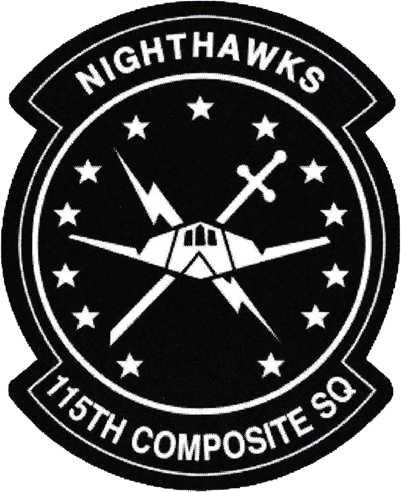 The meaning behind the patch
The patch is a combination of both CAP's Mission and our squadron name I mascot. Our unofficial mascot for the previous two years prior to this initiative or so had been the Flying Tigers, in honor of a World War II veteran guest speaker, but Hot Springs officially claimed that mascot in 2002 before we could. We don't have much information on how we came about selecting "Nighthawks" as our mascot name.
In December 2012, a second variation of the patch was approved by Col Alexander after updates were made including the addition of "Composite" in the name.
Information provided by:
Maj Charles Rine, Squadron Commander
July 11, 2016

The squadron patch for the Blackhawks was designed and developed in 2001 by the cadet members in the squadron. The top-half of the background is the American flag and serves as a tribute to this great nation that we serve. The lower-left quadrant of the background shows a flight of aircraft in perfect formation and symbolizes teamwork, precision, and of course, the United States Air Force. The lower-right quadrant of the background shows the outline of the great state of Arkansas. The squadron's namesake, the Blackhawk, is proudly displayed in the center of the patch.